 Italy
 Switzerland
 United Kingdom
 France
 Germany
 Spain
 Austria
 Sweden

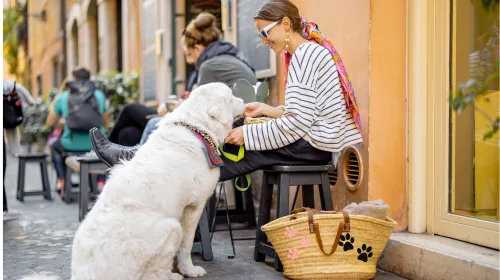
Dog restaurant etiquette in Italy comes down to one rule and a few habits. The rule: there is no single national right to bring a dog into a restaurant, so the owner or manager decides, and you should ask before you sit down. The habits: keep the dog on a short leash, settled beside or under your table rather than on a chair, and stay mindful of the tables around you. Do those and you will be welcome at most places that accept dogs at all.
Italian law supports the manager's right to decide. Under EU food hygiene rules, food businesses must stop domestic animals from entering areas where food is prepared, treated or stored (Regulation (EC) 852/2004, Annex II, Chapter IX), which is why kitchens and food counters are firmly off-limits. The Ministry of Health has said, in a note about supermarkets, that where local rules do allow animals into a sales area the business must still be able to show that animals cannot come into contact with food. For dining rooms, regions and municipalities set the detail. A 2013 restaurant-industry hygiene manual produced with the Ministry of Health stated that there are no hygiene grounds to stop dogs entering bars and restaurants, but that this applies only if the owner agrees and the dog has a leash and muzzle.
Are guide dogs treated differently from pet dogs?
The one exception is not up to the manager. Guide dogs for blind people must be admitted to premises open to the public under Law 37/1974, and obstructing that access carries an administrative fine of 500 to 2,500 euros. That applies to guide dogs, not to pet dogs travelling with you, so do not expect the same treatment for your own dog.
Your dog's behaviour is governed by the national rules on our muzzle and leash rules page, which apply in public places including a restaurant terrace: a leash of no more than 1.5 metres, and a muzzle carried and ready to put on, though not worn all the time. Regional rules add detail. Campania's 2021 regulation, for example, says that in dining areas an animal must not touch dishes, cookware or linen, must stay on the floor, and should look clean with a dry coat, and it asks the handler to carry a veterinary certificate valid for 60 days. Friuli Venezia Giulia, on its regional health pages, tells owners to clean up immediately if the dog soils a venue. Other regions differ, so treat these as examples, not a nationwide checklist.
How do I know if a restaurant accepts dogs in Italy?
Signs matter. Friuli Venezia Giulia states that a manager who bans dogs must display the notice visibly at the entrance, and that a ban shown by other means cannot be enforced. Managers there may also ban dogs only at certain hours or reserve certain areas for them. Campania likewise expects a notice at the entrance when access is refused. In practice, look for a no-dogs sign on the door, but if there is none, still ask. A missing sign is not an invitation to walk in with a dog that the staff do not expect.
Heat is the edge case that catches visitors out. On stone or concrete patios in summer the ground can become uncomfortably hot for paws even in shade, so bring a portable water bowl and something for the dog to lie on. If the only free table is in full sun on bare paving, choose another table or another place. Busy terraces with tight spacing are also where a nervous or reactive dog is least comfortable, so a quieter corner or an earlier sitting makes the meal easier for everyone.
What should I ask and bring before sitting down?
What to ask before you sit down: whether the dog is welcome at all, and whether it can come inside or only on the terrace. A quick 'il cane può venire?' (can the dog come in?) at the door costs nothing and avoids any awkwardness. If the answer is no, accept it politely and move on; the manager is within their rights. Keep a collapsible bowl, a mat or towel, waste bags and the muzzle in your bag, bring your dog already walked and calm, and do not feed it from the table or plates.